Which weight-loss medication is most effective?
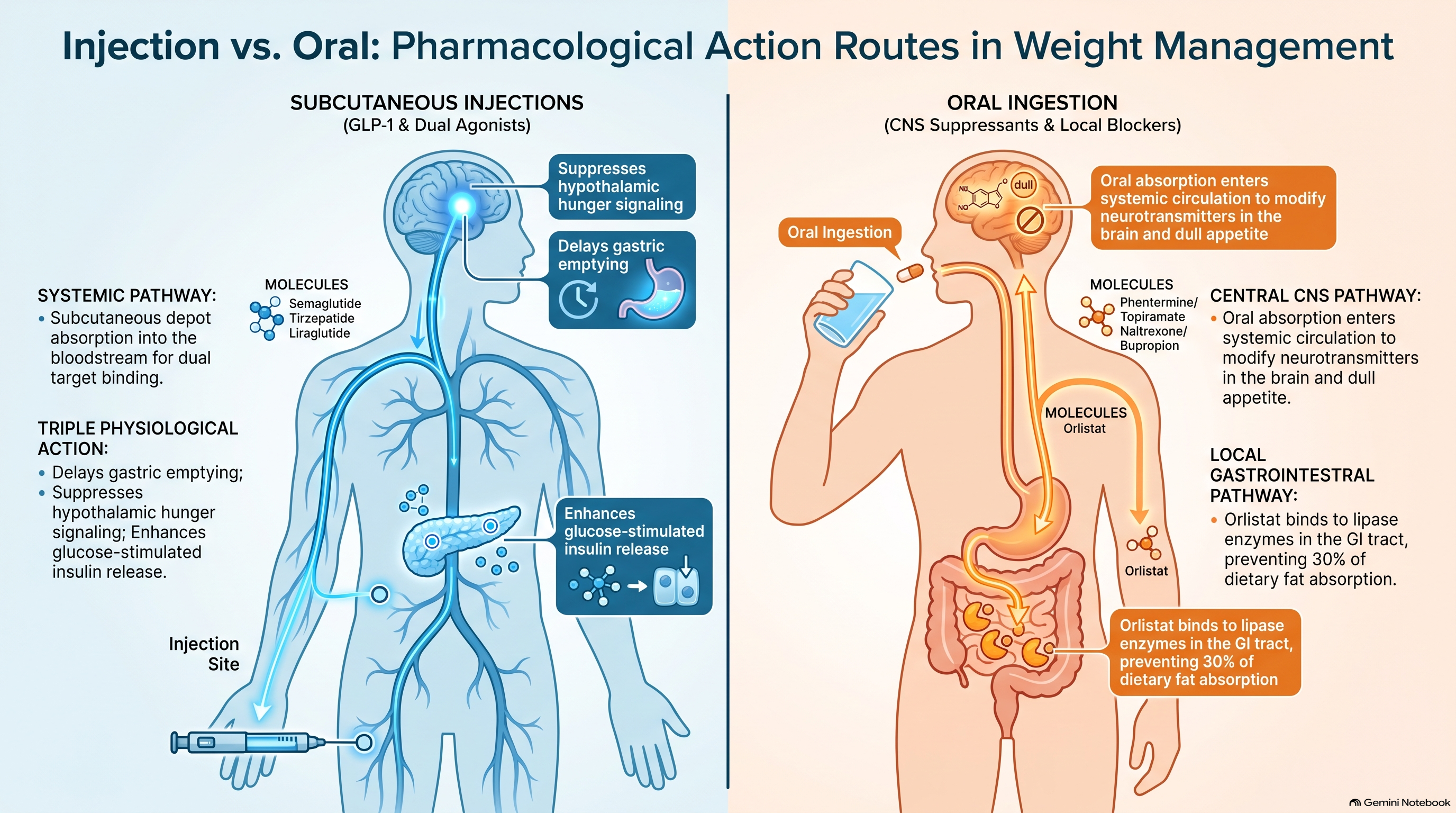
Tirzepatide (Zepbound) currently leads clinical efficacy: it targets both the GIP and GLP-1 pathways, producing the largest average weight loss in head-to-head data. Semaglutide (Wegovy), a GLP-1-selective agent, is close behind with a longer track record. Liraglutide (Saxenda) requires a daily injection instead of weekly, and orlistat (Alli/Xenical) is a non-hormonal oral option that blocks about 30% of dietary fat absorption — a very different mechanism with milder but real results. Most people who read this are comparing weight loss injections options around Daytona Beach, FL, so what follows sticks to the details that change in practice.
How do the mechanisms differ?
The table below lays out the four FDA-approved options side by side: receptor targets, route of administration, and the clinical checkpoints your provider will use. The most important pattern: the weekly injectables (Zepbound, Wegovy) dominate efficacy, while the oral (Alli) and daily (Saxenda) options serve specific patient profiles — cost sensitivity, injection aversion, or milder weight-loss goals.
The short version
- Tirzepatide (Zepbound) currently leads clinical efficacy, targeting both the GIP and GLP-1 pathways and producing the largest average weight loss in head-to-head data.
- Semaglutide (Wegovy) is a GLP-1-selective weekly injection positioned just behind with a longer track record, especially for type 2 diabetes with obesity.
- Liraglutide (Saxenda) is a GLP-1 agonist requiring daily subcutaneous injection rather than weekly, while orlistat is a non-hormonal oral option instead.
- Orlistat (Alli and Xenical) blocks about 30 percent of dietary fat absorption, a different mechanism that yields milder but real results.
- Weekly injectables dominate efficacy, while the oral and daily options serve patients who are cost-sensitive, injection-averse, or seeking milder weight-loss goals.
- Each program sets a three-to-four-month re-evaluation where weight loss is assessed and the dose adjusts or the medication switches.
What is the 3-4 month re-evaluation checkpoint?
Every program in Daytona Beach follows the same clinical rule: medications are assessed at 3 to 4 months. If weight loss is on track, treatment continues; if not, the dose adjusts or the medication is switched. This checkpoint is what separates real medical weight management from a prescription-and-pray approach.
The Data Table
| Medication Brand (Generic) | FDA Regulatory Status | Primary Receptor Target | Route of Administration | Biological Action (Brain/Digestive Tract) | Clinical Weight-Loss Efficacy Rating | Mandatory Dosing Timeline Checkpoint | Source |
|---|---|---|---|---|---|---|---|
| Tirzepatide (Zepbound) | FDA-approved for long-term weight management | Dual GIP/GLP-1 receptor agonist | Weekly subcutaneous injection | Slows gastric emptying, suppresses glucagon, and acts centrally on hypothalamic satiety | Rated with the highest clinical weight-loss efficacy of currently available options | Clinicians must re-evaluate patient progress at 3 to 4 months; if the patient has not achieved meaningful weight loss, the provider must adjust the dosage or switch medications | 1, 2, 3, 4, 6, User Description, User Instruction, Source material description and user instructions, Inferred from User Instructions |
| Semaglutide (Wegovy) | FDA-approved | Selective GLP-1 receptor agonist | Weekly subcutaneous injection | Suppresses glucagon, delays gastric emptying, and targets brain satiety centers; highly recommended for patients with concurrent type 2 diabetes and obesity | Highly recommended for patients with concurrent type 2 diabetes and obesity; highly effective | Clinicians must re-evaluate patient progress at 3 to 4 months; if the patient has not achieved meaningful weight loss, the provider must adjust the dosage or switch medications | 1, 2, 3, 4, 5, 6, 13, User Description, User Instruction, Source material description and user instructions, Inferred from User Instructions |
| Liraglutide (Saxenda) | FDA-approved | GLP-1 receptor agonist | Daily subcutaneous injection | Regulates postprandial blood sugar and appetite through intestinal and central mechanisms | Clinically effective weight management option; clinically significant efficacy | Clinicians must re-evaluate patient progress at 3 to 4 months; if the patient has not achieved meaningful weight loss, the provider must adjust the dosage or switch medications | 1, 2, 3, 4, 6, User Description, User Instruction, Source material description and user instructions, Inferred from User Instructions |
| Orlistat (Xenical/Alli) | FDA-approved | Local lipase blocker | Oral capsule | Blocks gastric and pancreatic lipases to prevent the digestion and absorption of up to 30% of dietary fat in the small intestine | Standard therapeutic efficacy for dietary fat absorption inhibition; supports meaningful weight loss; moderate efficacy | Clinicians must re-evaluate patient progress at 3 to 4 months; if the patient has not achieved meaningful weight loss, the provider must adjust the dosage or switch medications | 1, 2, 3, 4, 6, 10, 11, User Description, User Instruction, Source material description and user instructions, Inferred from User Instructions |
Visual Guide